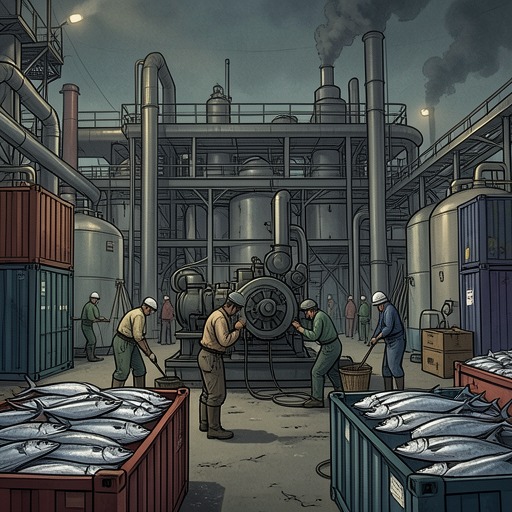
Florio family tuna-in-oil preservation trials
The Florios of SicilyThe Florio family tuna-in-oil preservation trials were Vincenzo Florio’s effort to turn declining demand for salted fish into an opportunity for commercial innovation. Working with Carlo Giachery, he tested whether tuna could be cooked, covered in oil, and sealed for long-term storage. The trials began in response to a market problem, but their significance widened: the proposed method would reshape processing at Favignana and bring whole families, rather than fishermen alone, into the seasonal work.
Market pressures and the remembered method
Sales of tuna had fallen not only in Sicily but at all tonnaras, while demand for sardines and mackerel was also weakening. Shipping companies and sailors were wary of brined fish because of the belief that it caused scurvy. Vincenzo rejected that explanation as a sufficient reason to abandon the trade, noting that his family had dealt in and eaten brined fish for years without the feared effects. The commercial problem, however, remained: a product distrusted by its customers could not be sold simply by insisting that the distrust was misplaced.
During a discussion with Giachery, the question of alternative preservation methods brought Vincenzo back to an image of his father soaking fish in oil after desalting it. The memory supplied a practical lead rather than a finished solution. Vincenzo turned to the date of the next mattanza at Arenella, due in ten days, and reasoned from cooking and preservation: if tuna were cooked, covered in oil, and kept in a sealed container, it might resist spoilage long enough for extended storage or an ocean voyage.
The year-long test
Vincenzo and Giachery began trials using tuna from Arenella and San Nicolò l’Arena. In May, after the first tonnaras were lowered and a plentiful catch was brought in, they stored tuna in oil in containers made of both tin and glass in Giachery’s pantry. The containers were kept there while the experiment ran its course; the test was not treated as proven merely because the fish had been prepared and sealed.
A year had to pass before they could determine whether the cooked tuna, covered in oil, would keep over the long term and withstand a sea voyage. That interval made patience part of the method: the proposed product’s value depended on whether it remained preserved after time, not on the promise of a new idea alone. Vincenzo pursued the trial stubbornly, convinced that without trying something new the existing situation could not change. The effort also expressed his desire to exert control over his life through practical work and experimentation.
From trial to Favignana
The experiment moved beyond the first sites when Vincenzo turned to the Favignana tonnara, which he had rented from the Pallavicinis of Genoa. Giachery had wondered whether taking on Favignana and Formica was too ambitious, since Vincenzo already had interests at Arenella, Sant’Elia, and Solanto. Vincenzo’s answer was grounded in the scale of the catch: Favignana and Formica together produced more tuna than the other three fisheries combined. He ordered olive oil and barrels for the Aegadian Islands and set out by sea with Giachery.
At Favignana, Vincenzo inspected the accounts and learned that three thousand tuna had already been caught in that May’s mattanza, with more expected as the season continued. He rejected the expectation that the island should continue producing only salted tuna. Shipping customers’ concerns about scurvy had left much of that product unsold, so he proposed a different system: cut and boil the fish, then preserve it in oil in airtight barrels. He told the overseer, Saro Ernandez, that this was not an untested whim; he had been developing the method for more than three years with tuna from Arenella and San Nicolò l’Arena, with Giachery’s help.
Production, labor, and significance
Vincenzo’s plan required changes to the marfaraggio, including an area with boilers for cooking the fish and accommodation for seasonal workers. He did not intend to rely only on fishermen: the operation would employ families, who would learn the new process together. When Ernandez doubted that the island’s impoverished residents could manage the work, Vincenzo’s response was to begin with the Florios’ own effort and teach the families. The proposed innovation therefore joined a new preservation process to a broader organization of labor.
He also intended to make use of materials left over from processing: tuna fat would be turned into lamp oil, and dry bones used for soil. The trials thus connected the problem of unsold fish to processing, storage, seasonal employment, and the use of by-products. Their narrative significance lies in the way Vincenzo treats commercial decline not as a reason to retreat, but as a demand to alter how the commodity is prepared, who takes part in producing it, and how much of the catch can be put to use. The evidence describes the test and its planned expansion, but does not establish the final outcome of the year-long trial.